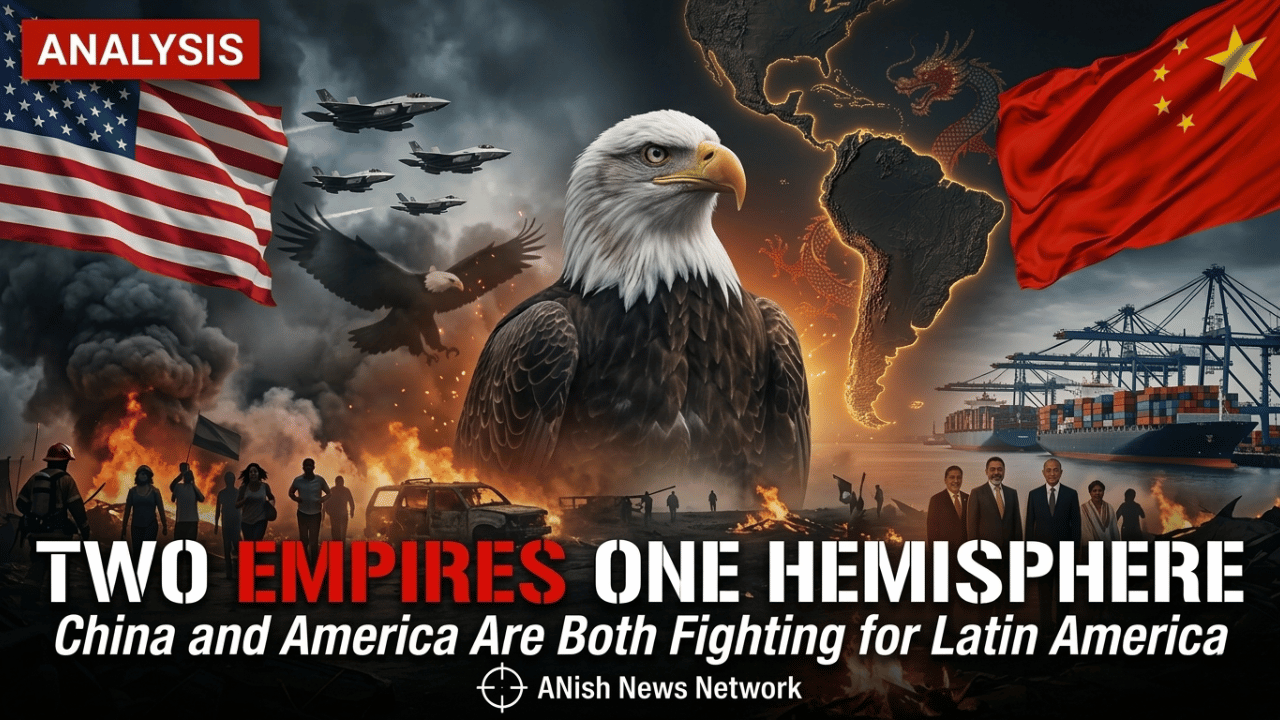
A cartoon eagle trapping doves in a cage. Eighteen seconds of animation. And somehow, China’s embassy said more about the current state of hemispheric politics than most diplomatic cables manage in eighteen pages.
The video produced by state media Xinhua and posted to X days after Trump’s Shield of the Americas Summit wasn’t subtle. It didn’t need to be. The message was blunt: America doesn’t protect Latin America, it controls it. The timing was deliberate. The audience wasn’t Washington. It was Brasília, Buenos Aires, Lima and Mexico City.
Beijing is not wrong that the US has a control problem in Latin America. But it is spectacularly hypocritical about its own.
The Summit Trump Needed and China Mocked
The Shield of the Americas Summit brought together right-wing and center-right leaders from 12 Latin American countries in Florida. Trump used the stage for two purposes: to propose a regional military coalition, and to warn about China’s expanding footprint in the Western Hemisphere.
Both goals are legitimate in isolation. A regional security framework isn’t inherently coercive. Concern about Chinese infrastructure investment in strategically sensitive locations isn’t paranoia. China’s port in Chancay, Peru inaugurated in 2024 with backing from state shipping giant COSCO dramatically cuts maritime transit times between South America and Asia. That is a commercial achievement with obvious strategic implications, and pretending otherwise is naive.
But Trump didn’t make a careful strategic argument. He invoked the Monroe Doctrine a 200-year-old declaration that the Western Hemisphere is America’s exclusive sphere and rebranded it the “Trump Corollary.” He falsely claimed China is “operating” the Panama Canal. He framed Latin American sovereignty as a security threat to be managed rather than a political reality to be respected.
That is not a competition strategy. That is an imperial reflex dressed in modern language.
What China Is Actually Doing
Strip away the propaganda and Beijing’s regional strategy is straightforward: trade, infrastructure, and debt in that order.
China is now one of the primary trading partners for multiple Latin American economies. Between January and November 2025, Chinese exports to the region grew 9.3% year-on-year. In Argentina governed by Javier Milei, one of Trump’s most enthusiastic allies in the region imports from China exceeded $16 billion in 2025, a 57% increase on the previous year. That is not a country being dragged into Beijing’s orbit. That is a country making rational economic decisions about where its goods come from.
This is the detail that makes Washington’s position strategically weak. The US is asking Latin American governments to treat Chinese trade relationships as security threats while offering comparatively little in economic terms to replace them. Warnings about “hostile foreign influence” land differently when the country issuing them hasn’t matched China’s infrastructure investment in the region, isn’t offering equivalent trade terms, and opens summits by recycling 19th-century doctrines about hemispheric dominance.
China’s response a cartoon was effective precisely because it required no rebuttal of specific facts. It simply reflected back the optics of what Washington was doing and let the image do the work.
The Hypocrisy Is Mutual and Structural
Beijing’s video frames China as the reasonable party offering partnership while America offers a cage. This is propaganda, and effective propaganda at that. But it deserves to be examined rather than dismissed.
China does not offer Latin American countries a partnership of equals. The Belt and Road model large infrastructure loans tied to Chinese contractors, denominated in terms favorable to Beijing has left some recipient countries with debt obligations that constrain their policy choices. The Chancay port deal gives COSCO a dominant position in a critical Pacific gateway. Chinese telecommunications infrastructure in the region carries the same data sovereignty concerns that Western governments raise about Huawei everywhere else.
Beijing is not building friendships in Latin America. It is building dependencies. The difference between that and what Washington offers is narrower than either side will admit.
What Latin American governments are actually navigating is a competition between two powers, neither of which is primarily concerned with their interests. The US wants strategic denial keeping China out. China wants strategic access ports, data, commodities, political relationships. In both cases, Latin America is the terrain, not the protagonist.
Why the Cartoon Won the News Cycle
The Shield of the Americas Summit generated substantial coverage. Trump’s warning about Chinese influence, the proposed military coalition, the Monroe Doctrine revival all of it was reported, analyzed and debated.
And then an 18-second animation of a cartoon eagle putting doves in a cage cut through all of it.
That is a communications lesson worth understanding. China did not win that news cycle because its position is morally superior or strategically coherent. It won because the visual it offered security becoming control, a promise becoming a trap was more memorable than anything produced by a summit that spent considerable effort and political capital making exactly the opposite case.
Trump’s instinct that China is competing for influence in Latin America is correct. His method of responding to it invoking territorial doctrines, spreading misinformation about the Panama Canal, framing multilateral summits as loyalty tests is handing Beijing a propaganda gift every time he speaks.
Competing with China in Latin America requires offering something better, not just declaring the region off-limits. Trade access. Infrastructure investment. Debt relief. Genuine respect for political sovereignty, including the sovereignty to trade with whoever offers the best terms.
A cage, however well-intentioned, is still a cage. Beijing knows that. It made a cartoon about it. Washington, apparently, has not yet figured out why that cartoon landed.