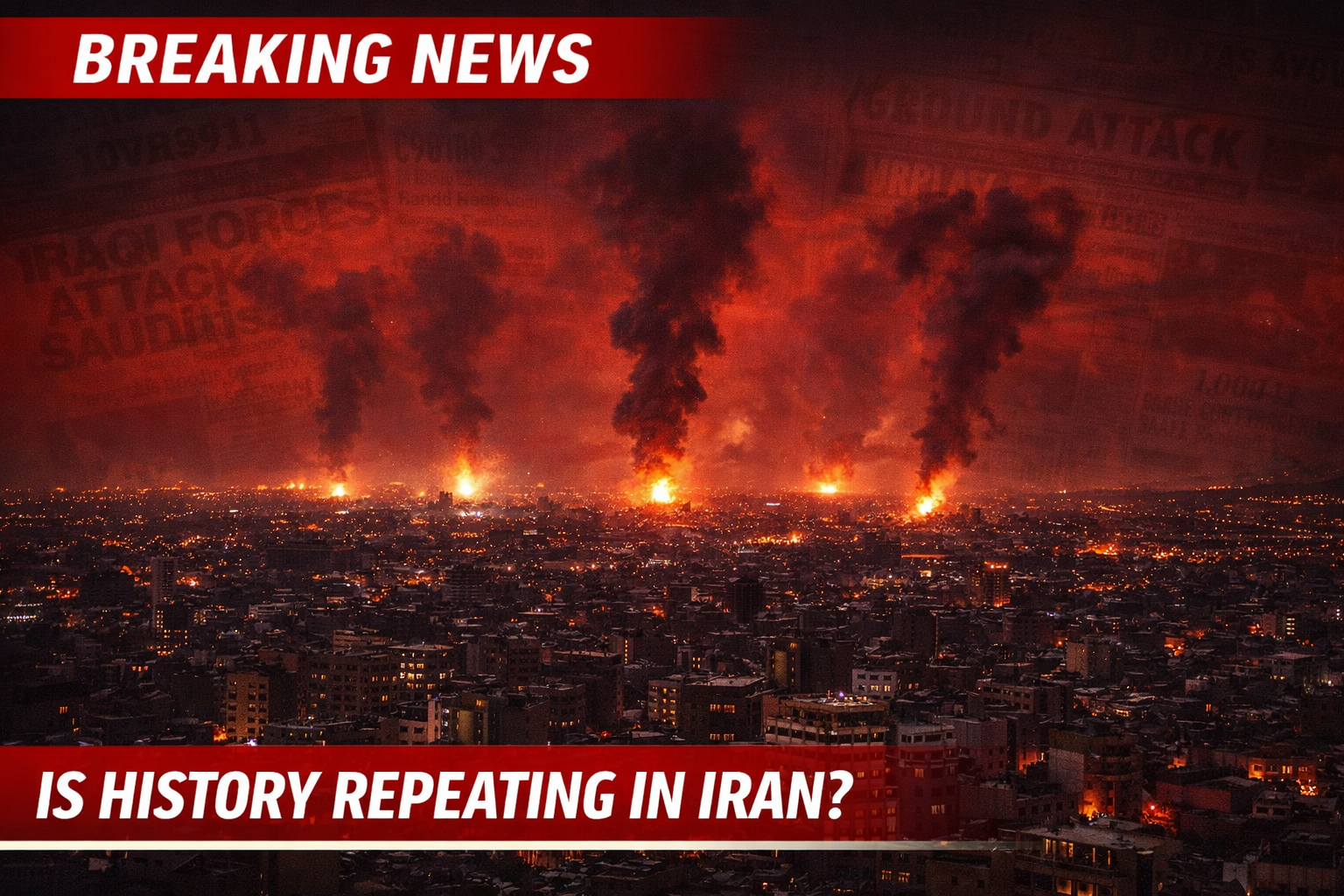
By ANish News Desk | World News Reporter | aromanish.com Published: March 11, 2026 | Estimated Read Time: 6 minutes This article draws on analysis from BBC News, Reuters, and open-source regional intelligence reporting. The ANish News editorial team has independently verified all facts.
Thirty-five years ago, an American president stood in a Massachusetts missile factory, praised the workers, and said something he would spend the rest of his life regretting. George H.W. Bush told the Iraqi people to rise and overthrow Saddam Hussein — then stood aside as Hussein’s helicopters slaughtered the thousands who believed him. Today, Donald Trump and Israeli Prime Minister Benjamin Netanyahu are urging the Iranian people to overthrow the Islamic Republic, making no promises of military support, against a backdrop of mounting civilian casualties and a war without a publicly stated endgame. For students of Middle Eastern history, the consequences of the Iran war are already beginning to feel uncomfortably familiar.
How the Gulf War History of False Promises Haunts the Iran Crisis
The pattern did not begin in 2003. It began in 1991, when the first Gulf War ended with Saddam Hussein still in power despite a crushing military defeat. After Bush’s speech urging Iraqis to take matters into their own hands, Iraqi Shia Muslims in the south and Kurds in the north launched armed uprisings against Hussein’s regime, believing they had American backing.
They were wrong. The coalition watched and did not intervene. Hussein’s forces — crucially allowed to retain their helicopter gunships under the ceasefire terms — launched a brutal counter-offensive. Thousands of Kurds and Shia Iraqis were killed. Tens of thousands more fled to the mountains. Eyewitness accounts from journalists on the ground described fathers carrying children who had died overnight on freezing mountainsides.
The Americans, British, and French were eventually shamed into a large-scale humanitarian response for the Kurds. The Shia in the south received no such intervention.
That war’s consequences stretched forward for more than a decade. Permanent US bases in Saudi Arabia radicalised a young Osama bin Laden, whose organisation became Al Qaeda. Each Gulf war, as veteran correspondents have noted, planted the seeds of the next. The 2003 invasion to finish what Bush Senior started removed Saddam Hussein — and handed Iran a historic strategic victory by eliminating its most dangerous regional rival.
The 2026 Iran War: Strategic Goals and Dangerous Uncertainties
The current conflict, launched jointly by the US and Israel on February 28, 2026, is explicitly designed to undo the regional power gains Iran accumulated after 2003. The bombing campaign targets Iran’s military infrastructure and nuclear programme — capabilities that Israel, in particular, has long described as an existential threat.
Netanyahu has been unusually candid about his personal motivations. In a speech on the war’s second day, he described the strikes as fulfilling a goal he had pursued for forty years, framing it as the destruction of what he called a terror regime. His vision extends beyond Iran’s nuclear programme. Israel is simultaneously pressing operations against Hezbollah in Lebanon — an objective it has pursued, unsuccessfully, since the 1990s — while advancing further steps toward effective annexation of the occupied West Bank. With global attention fixed on Iran, that parallel agenda is proceeding largely unexamined.
Trump, meanwhile, has been simultaneously claiming total military victory over Iran and acknowledging that significant Iranian capabilities remain intact. At a Monday press conference, he claimed US forces had “wiped every single force in Iran out, very completely,” only to follow that with references to “most” of Iran’s naval power being sunk and an “over 90% decline” in missile launchers — figures that independent analysts cannot verify. Iran’s new Supreme Leader, Mojtaba Khamenei, son of the late Ali Khamenei, has assumed power, and the Islamic Republic’s governing structures remain functional.
The war is polling poorly in America. Trump, who campaigned explicitly on ending foreign wars, now oversees the first joint US-Israeli military operation in history — one that US allies in Europe have openly condemned for lacking UN authorisation or a credible self-defence justification. Defense Secretary Pete Hegseth dismissed European concerns at a recent briefing, mocking allies who “wring their hands and clutch their pearls” about the use of force.
What This Means for Ordinary People in the Region and Beyond
The human cost of the conflict is already severe and climbing. Iranian state media reported more than 165 deaths — including many schoolgirls — in the strike on an elementary school in Minab adjacent to an IRGC naval base. US weapons experts and multiple news organisations identified the missile as American-made. The Trump administration has not accepted responsibility.
For ordinary Iranians, the geopolitical stakes are secondary to immediate survival. The population has already suffered years of crippling economic sanctions, internal repression — including the killing of thousands of protesters in January 2026 — and now sustained aerial bombardment of military and infrastructure targets.
For American and global consumers, the economic pain is tangible at petrol stations and supermarkets. Oil above $90 per barrel, a near-shutdown of the Strait of Hormuz, and surging natural gas prices are feeding into freight costs, food prices, and airline fares worldwide. The Gulf states that sought to prevent this war now find themselves targets of Iranian retaliation, with their alliance calculations toward the US shifting visibly under the pressure.
Analysts at Chatham House warned this week that the greatest risk is not the war’s opening phase — it is the vacuum that follows if the Islamic Republic collapses without a credible replacement structure in place.
What To Expect Next
- The regime change question has no clear answer. Trump and Netanyahu have called for an Iranian popular uprising, but provided no framework for what replaces the Islamic Republic if it falls. The 2003 Iraq precedent is explicit: removing a government without a replacement plan produced years of sectarian violence, civil war, and the eventual emergence of Islamic State. Iran, with a population of 90 million, a sophisticated bureaucratic state, and deep regional entanglements, presents a far more complex post-conflict environment than Iraq did. Analysts across the political spectrum are flagging this gap as the war’s most dangerous blind spot.
- China’s position will determine the region’s long-term alignment. Gulf states that built relationships with both Washington and Beijing over the past decade are now reassessing those calculations under wartime pressure. If Trump declares victory and reduces US engagement, Saudi Arabia and its neighbours may accelerate their pivot toward Chinese security and economic partnerships — a strategic outcome that would represent a significant long-term loss for US regional influence, regardless of what happens to Iran’s regime.
- The war’s end conditions remain publicly undefined. Unlike the 1991 Gulf War, which had a clear and legally authorised objective — expelling Iraqi forces from Kuwait — the current conflict lacks a published set of conditions for cessation. Destroying Iran’s nuclear programme is a technical goal. Destroying the Islamic Republic is a political one. Achieving both, simultaneously, through air power alone, has no modern precedent. Military historians and strategic analysts are in unusual agreement that without defined end conditions, escalation risk remains extremely high.
Frequently Asked Questions
Why did the US and Israel attack Iran in 2026?
The US and Israel launched joint military operations against Iran on February 28, 2026, with the publicly stated goals of destroying Iran’s nuclear programme and degrading its military capabilities. Israel, under Prime Minister Netanyahu, has long regarded Iran’s nuclear ambitions and regional influence as an existential threat. The Trump administration aligned with that assessment, marking the first joint US-Israeli combat operation in history. The war lacks UN Security Council authorisation and has drawn sharp criticism from European and Asian allies.
How does the Iran war compare to the 2003 Iraq invasion?
The parallels are significant and widely discussed by historians and analysts. Both conflicts involved US military action against a Middle Eastern government without UN authorisation, both were launched with regime change as an implicit or explicit goal, and neither began with a clearly defined plan for post-conflict governance. The 2003 Iraq invasion removed Saddam Hussein but produced years of civil war, hundreds of thousands of civilian deaths, and the conditions that gave rise to Islamic State. Analysts warn Iran’s greater size, population, and regional influence make the stakes of an unplanned collapse far higher.
What does Netanyahu want from the Iran war?
Netanyahu has been unusually explicit. In a speech on the war’s second day, he described the conflict as fulfilling a personal objective pursued over four decades: destroying the Islamic Republic of Iran. His goals also include the permanent destruction of Hezbollah in Lebanon and consolidating Israeli military dominance across the region. Israel’s simultaneous moves on the West Bank suggest Netanyahu is pursuing a broad regional reordering under the cover of the Iran campaign.
What are the risks of regime change in Iran?
The primary risk is the governance vacuum that follows collapse. Iran has a population of approximately 90 million people, a deeply embedded state bureaucracy, and complex regional relationships with Iraq, Syria, Lebanon, and Yemen. If the Islamic Republic collapses without a viable replacement structure, the result could be prolonged civil conflict, the fragmentation of state authority, and a power vacuum that extremist groups could exploit — echoing the post-2003 Iraq experience at a far larger scale.
Could the Iran war lead to a wider regional conflict?
It already has, to a significant degree. Iran has effectively closed the Strait of Hormuz to oil tankers, driving global crude prices above $90 per barrel. Three ships were struck by unknown projectiles near the Strait this week. Gulf states that sought to prevent the war are now being drawn in as targets of Iranian retaliation. If Iran’s mining of the strait intensifies, or if Hezbollah escalates in Lebanon, the conflict could draw in additional regional actors. China’s strategic calculations — whether to deepen Gulf partnerships or maintain distance — could also reshape the conflict’s trajectory significantly.
ANish News Analysis
What makes this story significant beyond the headlines is the absence of any publicly stated theory of victory. Launching a war is a decision. Ending one is a strategy — and there is no evidence that a coherent strategy exists here.
Historically, the US military has been extraordinarily effective at destroying things. It has been far less effective at determining what should replace them. The first Gulf War, the second Gulf War, the Libya intervention, and the Afghanistan campaign all share a common feature: the post-conflict phase was either unplanned or optimistically mismanaged. In each case, the human and strategic costs of the aftermath exceeded the costs of the initial campaign.
The detail most analysts are overlooking amid the oil price coverage and the missile identification debates is the Bush 1991 parallel at the heart of this story. Trump and Netanyahu are explicitly encouraging Iranians to rise up. If the Islamic Republic falls — or is severely weakened — and no uprising materialises with enough coherence to form a stable alternative government, the US and Israel will face a choice: occupy, abandon, or watch chaos spread. None of those options is good. The one they appear least prepared for is the third — because historically, it is the one that has always arrived.
The Ghosts of Gulf Wars Past
The Iran war consequences are being written in real time, and the early chapters carry an unmistakeable echo. A US president encouraging a population to revolt without promising the military support to protect them. An Israeli prime minister pursuing a lifelong geopolitical vision with American firepower. An oil market in crisis, allies alarmed, and a watching world uncertain whether this ends in transformation or catastrophe.
Trump may yet be proved right — that destroying the Islamic Republic makes the world safer, and that the Iranian people seize the moment to build something better. But the history of every previous Gulf War says the harder question is not whether you can win. It is what happens the morning after.
Stay updated with ANish News Network for the latest on the Iran war and its global consequences. Bookmark aromanish.com and follow us for real-time coverage.