How AI Search Optimization Differs from Traditional SEO
 By ANish Team
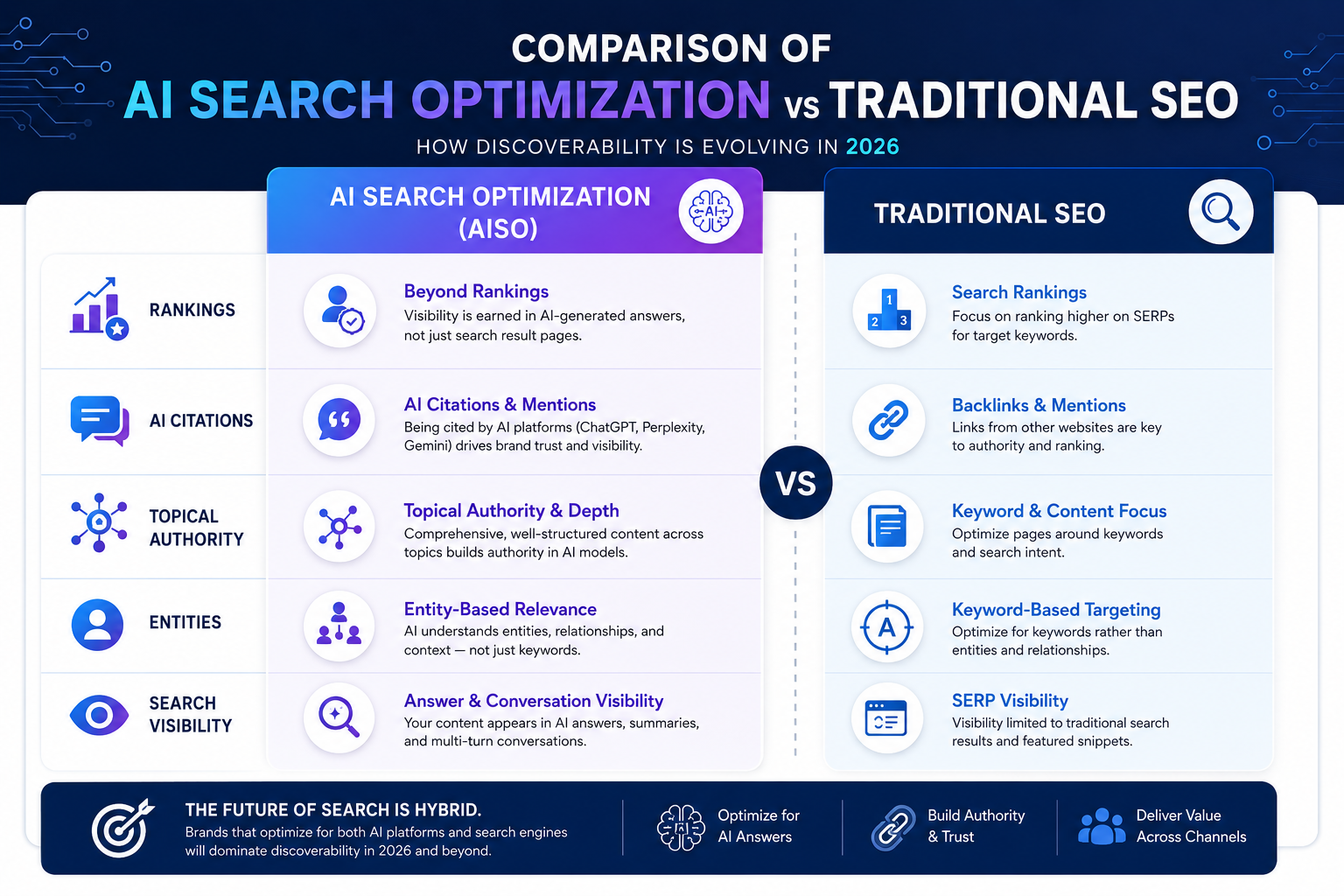
AI Search Optimization (AISO) focuses on helping content become discoverable, understandable, and cite-worthy for AI-powered search engines and assistants. In contrast, traditional SEO primarily focuses on ranking web pages in search engine results pages (SERPs). In 2026, businesses need both approaches because consumers increasingly find information through ChatGPT, Google AI Overviews, Gemini, Claude, and Perplexity in addition to traditional Google searches.
For years, SEO was largely about improving rankings on search engines. Today, search behavior is changing. Instead of clicking through multiple websites, users often receive direct answers from AI systems. This shift requires marketers to rethink how content is created, structured, and optimized.
What Is Traditional SEO?
Traditional SEO is the practice of improving a website’s visibility in search engine results through technical optimization, content creation, keyword targeting, and link building.
The primary goal is to increase rankings for specific search queries.
Traditional SEO typically focuses on:
- Keyword optimization
- Backlink acquisition
- Technical SEO
- On-page optimization
- User experience signals
- Search engine rankings
- Organic traffic growth
For example, if someone searches “best CRM software,” traditional SEO aims to help a page rank on the first page of Google.
For more than two decades, this approach has been the foundation of organic search marketing.
What Is AI Search Optimization?
AI Search Optimization (AISO) is the process of creating content that AI systems can easily understand, trust, summarize, and reference when generating answers.
Instead of optimizing only for rankings, AISO optimizes for citations, recommendations, and inclusion in AI-generated responses.
Platforms influencing AI search include:
- ChatGPT
- Google AI Overviews
- Gemini
- Perplexity
- Claude
- Microsoft Copilot
The goal is not simply to rank but to become a trusted source that AI systems choose to reference.
This requires a stronger focus on expertise, topical depth, content clarity, and contextual relevance.
Traditional SEO vs AI Search Optimization
Traditional SEO and AI Search Optimization share some fundamentals, but their objectives and optimization methods differ significantly.
| Factor | Traditional SEO | AI Search Optimization |
|---|---|---|
| Primary Goal | Rankings | Citations & Recommendations |
| Focus | Keywords | Topics & Entities |
| Success Metric | Organic Traffic | AI Mentions & Visibility |
| Content Structure | Search-Friendly | AI-Friendly & Search-Friendly |
| Authority Signals | Backlinks | Expertise + Authority + Trust |
| User Journey | Click-Based | Answer-Based |
| Optimization Method | SERP Ranking | Knowledge Extraction |
Businesses that rely only on traditional SEO may miss visibility opportunities in AI-powered discovery channels.
Why Keywords Matter Less in AI Search
Keywords remain important, but AI systems rely more heavily on context, semantics, and user intent.
AI models analyze:
- Meaning
- Relationships between concepts
- Entity connections
- Topical authority
- Content completeness
For example, a traditional SEO strategy might target:
“email marketing software”
An AI search strategy would cover:
- Email marketing automation
- Customer retention
- Lead nurturing
- Campaign analytics
- Deliverability
- Customer lifecycle marketing
The broader topic coverage helps AI systems understand expertise and context.
Why Topical Authority Matters More Than Ever
AI systems prefer sources that demonstrate comprehensive expertise rather than isolated keyword targeting.
Topical authority is built by covering an entire subject area in depth.
For example, a digital marketing agency could build authority through content covering:
- SEO
- AI SEO
- Content marketing
- Conversion optimization
- Analytics
- Social media marketing
- Lead generation
When AI systems consistently see high-quality content across related subjects, they gain stronger confidence in that source.
This increases the likelihood of being cited in AI-generated responses.
The Role of Entities in AI Search
Entities help AI systems understand concepts, organizations, technologies, and relationships.
Examples include:
- OpenAI
- Google Analytics
- Google Search Console
- HubSpot
Traditional SEO often focuses heavily on keywords.
AI Search Optimization focuses on helping systems understand relationships between entities and topics.
This is one reason comprehensive content often outperforms narrowly optimized pages.
Content Structure Becomes More Important
AI systems frequently extract information directly from content.
Well-structured content improves the chances of being cited.
Effective AI-friendly content includes:
- Direct answers
- Clear headings
- FAQ sections
- Definitions
- Tables
- Lists
- Supporting examples
A strong article should answer the reader’s question immediately before expanding on details.
This approach benefits both users and AI systems.
AromaNish Insight
Across hundreds of marketing campaigns, one pattern has become increasingly clear: pages that rank well are not always the pages that AI systems reference.
In many cases, AI tools prefer content that:
- Clearly answers questions
- Demonstrates expertise
- Covers related concepts
- Uses structured formatting
- Includes real-world examples
Some lower-ranking pages receive AI citations because they provide better contextual answers than higher-ranking competitors.
This highlights a growing distinction between ranking optimization and answer optimization.
Businesses should increasingly focus on both.
Real-World Example
In a recent content optimization project, an article targeting a competitive keyword performed reasonably well in traditional search but received limited AI visibility.
The content was restructured to include:
- Direct-answer introductions
- Expanded topical coverage
- FAQ sections
- Entity references
- Practical examples
Although rankings improved modestly, visibility across AI-powered discovery tools increased significantly because the content became easier for AI systems to understand and summarize.
This illustrates how AI Search Optimization extends beyond traditional SEO techniques.
Common Mistakes Businesses Make
Many organizations are still optimizing exclusively for older search models.
Common mistakes include:
Over-Focusing on Keywords
Keyword targeting remains useful, but content should answer broader user needs.
Publishing Thin Content
Short, surface-level articles often lack the depth AI systems prefer.
Ignoring Expertise Signals
Author credibility, experience, and trust indicators matter increasingly.
Neglecting Content Structure
Poor formatting makes it harder for AI systems to extract useful information.
Treating AI Search as a Separate Channel
The most successful strategies integrate traditional SEO and AI Search Optimization rather than choosing one over the other.
Soft Service Mention
As AI-powered discovery becomes more influential, businesses are increasingly combining SEO with AI Search Optimization strategies to improve both rankings and AI visibility. An integrated content strategy helps maximize visibility across traditional and emerging search experiences.
How to Prepare for AI Search Optimization
Businesses should view AI Search Optimization as an evolution of SEO rather than a replacement.
Practical steps include:
- Build topical authority.
- Publish comprehensive content.
- Add FAQ sections.
- Improve content structure.
- Demonstrate expertise.
- Include real-world examples.
- Strengthen brand authority.
- Focus on user intent.
- Maintain technical SEO best practices.
- Monitor AI search visibility.
Organizations that begin adapting now will have a stronger competitive advantage as AI-driven search continues growing.
The Future of Search
Search is becoming increasingly conversational, contextual, and AI-assisted.
Users are moving from:
“Find me websites”
to
“Give me the answer.”
As this trend accelerates, businesses will need content that can:
- Rank in search engines
- Appear in AI Overviews
- Be cited by AI assistants
- Build trust with users
- Support buying decisions
The future belongs to brands that can do all of these simultaneously.
Conclusion
Traditional SEO remains critical for organic visibility, but AI Search Optimization introduces a new layer of competition focused on citations, authority, and answer quality.
Businesses that combine strong SEO fundamentals with AI-friendly content structures, topical authority, and expertise-driven publishing will be better positioned for the future of search.
Want your business to be found not only on Google but also in ChatGPT, Google AI Overviews, Gemini, and Perplexity?
AromaNish helps businesses develop AI-ready SEO and content strategies designed for modern search behavior. Schedule a Free Strategy Call or request a Free Quote to explore opportunities for growth. We provide transparent reporting, practical recommendations, and no long-term contracts.
Prefer a quick conversation? Reach out via WhatsApp or visit our Contact Page.
What To Read Next
The next question you’re likely asking:
- Digital Marketing Trends in 2026
- How to Build Topical Authority for SEO and AI Search
- Content Marketing Strategies That Work in the AI Era
Last Updated: June 2026
