Digital Marketing Trends in 2026: What Businesses Need to Know
 By ANish Team
Introduction
Digital marketing trends in 2026 are being shaped by artificial intelligence, evolving search behavior, privacy-focused data practices, and increasing demand for personalized customer experiences. Businesses that adapt to AI-powered discovery, first-party data strategies, video content, and omnichannel marketing will be better positioned to generate leads, improve customer engagement, and achieve sustainable growth.
Digital marketing is no longer just about ranking on Google or running social media ads. Consumers now discover brands through AI assistants, video platforms, social search, voice interactions, and personalized recommendations. As technology evolves, marketers must rethink how they attract, engage, and convert audiences.
In this guide, we’ll explore the most important digital marketing trends in 2026 and how businesses can leverage them effectively.
Why Digital Marketing Is Changing Faster Than Ever
Digital marketing is evolving rapidly because consumer behavior, AI technology, and privacy regulations are changing how people discover and interact with brands.
Several major shifts are driving this transformation:
- AI-powered search experiences
- Declining reliance on third-party cookies
- Growth of video-first platforms
- Increased demand for personalization
- Multi-channel customer journeys
- Greater focus on customer trust and transparency
Platforms such as ChatGPT, Google AI Overviews, Gemini, Perplexity, LinkedIn, YouTube, Meta Ads, and TikTok are reshaping how businesses reach potential customers.
Companies that continue using outdated marketing tactics risk losing visibility and market share.
Trend #1: AI-Powered Search Optimization Becomes Essential
AI search optimization is becoming as important as traditional SEO because consumers increasingly use AI assistants to find answers and recommendations.
Google AI Overviews, ChatGPT, Gemini, Claude, and Perplexity now influence buying decisions across multiple industries.
Businesses should focus on:
- Comprehensive content
- Expert insights
- Original research
- Clear answers to user questions
- Structured information
- Entity-based optimization
Instead of optimizing only for keywords, marketers must optimize for topics, expertise, and user intent.
What This Means for Businesses
Content should be created to answer complete questions rather than targeting isolated keywords.
For example, a company selling CRM software should create content covering:
- CRM implementation
- Customer retention
- Sales automation
- Lead management
- ROI measurement
This increases the likelihood of being cited by AI systems and appearing in AI-generated responses.
Trend #2: First-Party Data Becomes a Competitive Advantage
First-party data is becoming one of the most valuable assets for marketers as privacy regulations continue to evolve.
Businesses can no longer rely heavily on third-party tracking methods.
Effective first-party data strategies include:
- Email subscriptions
- Lead magnets
- Customer surveys
- Loyalty programs
- Website behavior analytics
- CRM systems
According to industry guidance from Google and major analytics providers, organizations that develop strong first-party data ecosystems will gain more accurate audience insights and better campaign performance.
Trend #3: Hyper-Personalization Through AI
AI-powered personalization allows brands to deliver highly relevant content, recommendations, and offers to individual users.
Consumers increasingly expect:
- Personalized emails
- Dynamic website experiences
- Relevant product suggestions
- Customized advertising
- Tailored content recommendations
Modern marketing platforms can analyze user behavior in real time and adapt messaging accordingly.
The result is often:
- Higher engagement
- Improved conversion rates
- Better customer retention
- Increased customer lifetime value
Trend #4: Video Continues to Dominate Customer Attention
Video remains one of the most effective formats for education, engagement, and lead generation.
Short-form videos continue performing exceptionally well across:
- YouTube Shorts
- TikTok
- Instagram Reels
- LinkedIn Video
- Facebook Video
However, long-form educational content is also growing in importance.
Businesses should create:
| Content Type | Purpose |
|---|---|
| Short-form videos | Awareness |
| Tutorials | Education |
| Product demonstrations | Conversion |
| Case studies | Trust building |
| Webinars | Lead generation |
Video content helps businesses communicate expertise more effectively than text alone.
Trend #5: Social Search Is Replacing Traditional Search for Many Users
Social platforms are increasingly being used as search engines, particularly among younger audiences.
Users now search directly on:
- TikTok
- YouTube
People often trust creator recommendations and user experiences more than traditional advertising.
Brands should optimize social content using:
- Search-friendly captions
- Relevant hashtags
- Educational content
- Frequently asked questions
- Clear topic organization
This improves discoverability both within platforms and through external search engines.
AromaNish Insight
Across campaigns involving businesses in multiple industries, one consistent pattern has emerged: brands that combine SEO, content marketing, and social media strategy tend to achieve stronger long-term results than businesses relying on a single channel.
Many organizations still treat SEO, social media, and content creation as separate activities. In reality, the highest-performing campaigns integrate these disciplines into one growth system.
For example:
- SEO identifies demand.
- Content addresses audience questions.
- Social media amplifies visibility.
- Conversion optimization turns traffic into leads.
This integrated approach often produces more sustainable growth than isolated marketing efforts.
Trend #6: Customer Experience Becomes a Ranking and Revenue Factor
Customer experience is becoming increasingly important across every stage of the marketing funnel.
Factors influencing success include:
- Website speed
- Mobile usability
- Navigation clarity
- Content quality
- Trust signals
- Checkout experience
A positive experience improves:
- Search visibility
- Conversion rates
- Customer retention
- Brand perception
Businesses should regularly audit customer journeys to identify friction points and opportunities for improvement.
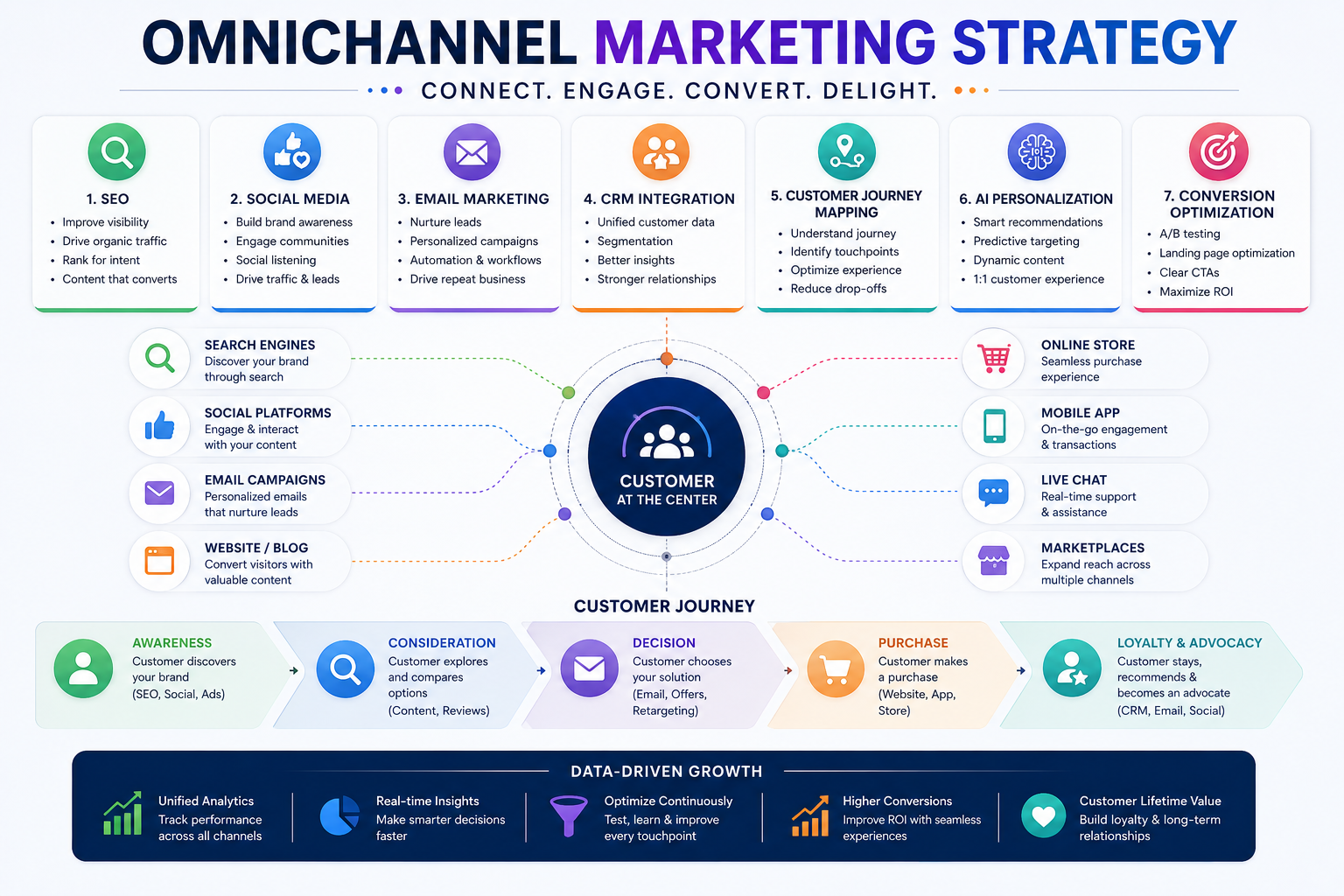
Trend #7: Omnichannel Marketing Becomes Standard
Customers rarely interact with a brand through a single channel.
A typical journey might involve:
- Discovering a brand through social media.
- Researching via Google.
- Reading reviews.
- Visiting the website.
- Receiving email follow-ups.
- Making a purchase.
Successful marketers ensure consistent messaging across all touchpoints.
An omnichannel approach improves customer trust and creates a more seamless buying experience.
A Real-World Example
In a recent digital marketing project, a business was generating most of its leads through paid advertising alone.
After implementing:
- SEO improvements
- Educational blog content
- Email nurturing
- Conversion optimization
- Social content distribution
the company diversified its lead sources and reduced dependence on paid traffic.
This reflects a broader trend observed across growth-focused organizations: sustainable results often come from building multiple acquisition channels rather than relying on a single source.
Soft Service Mention
Businesses looking to adapt to these digital marketing trends often benefit from a structured growth strategy that aligns SEO, content marketing, social media, and conversion optimization efforts. A well-executed digital marketing strategy can help organizations stay competitive as search and customer behavior continue evolving.
How Businesses Should Prepare for Digital Marketing in 2026
Businesses should focus on building marketing systems rather than chasing individual tactics.
Recommended priorities include:
1. Invest in AI-Ready Content
Create authoritative content that answers real customer questions.
2. Strengthen First-Party Data Collection
Develop ethical and transparent methods for gathering customer insights.
3. Improve Website Experience
Optimize speed, usability, and conversion paths.
4. Expand Video Marketing
Use both short-form and long-form video formats.
5. Integrate Marketing Channels
Ensure consistency across search, social, email, and website experiences.
6. Measure Business Outcomes
Track leads, sales, and customer value—not just traffic and impressions.
The Future of Digital Marketing Beyond 2026
Digital marketing will continue moving toward:
- AI-assisted discovery
- Predictive personalization
- Conversational search
- Privacy-focused analytics
- Experience-driven marketing
- Multi-platform customer journeys
Businesses that prioritize trust, expertise, and customer value will remain competitive regardless of technological changes.
The fundamentals remain the same: understand your audience, provide value, and build meaningful relationships.
Conclusion
Digital marketing trends in 2026 highlight a clear shift toward AI-powered discovery, personalization, first-party data, omnichannel engagement, and superior customer experiences.
Organizations that embrace these changes early will be better positioned to attract qualified traffic, generate leads, and build long-term customer relationships.
Want a practical digital marketing strategy tailored to your business goals?
AromaNish helps businesses grow through SEO, content marketing, social media strategy, and conversion-focused digital campaigns. Schedule a Free Strategy Call or request a Free Quote to explore opportunities for growth. With transparent reporting and no long-term contracts, you’ll always know exactly how your marketing investment is performing.
Prefer a quick conversation? Reach out via WhatsApp or visit our Contact Page.
What To Read Next
The next question you’re likely asking:
- How AI Search Optimization Differs from Traditional SEO
- First-Party Data Strategies for Modern Businesses
- How to Build an Omnichannel Marketing Strategy That Converts
Discussion Question
Which digital marketing trend do you believe will have the biggest impact on your business over the next 12 months—and why?
FAQ Section
How is AI changing digital marketing in 2026?
AI is changing digital marketing by improving personalization, content creation, audience analysis, customer support, and search experiences. Businesses are increasingly optimizing content for AI-powered platforms such as ChatGPT, Gemini, and Google AI Overviews.
Is SEO still important in 2026?
Yes. SEO remains important, but it now includes optimization for AI search systems, topical authority, user experience, and content quality in addition to traditional keyword strategies.
What is the biggest digital marketing trend in 2026?
AI-powered search and discovery is one of the most significant trends because it directly affects how consumers find information and make purchasing decisions.
Why is first-party data important?
First-party data provides businesses with reliable customer insights while supporting privacy compliance and improving marketing effectiveness.
Should businesses invest more in video marketing?
For many businesses, yes. Video remains one of the most effective ways to build trust, educate audiences, and increase engagement across multiple platforms.